






The Context
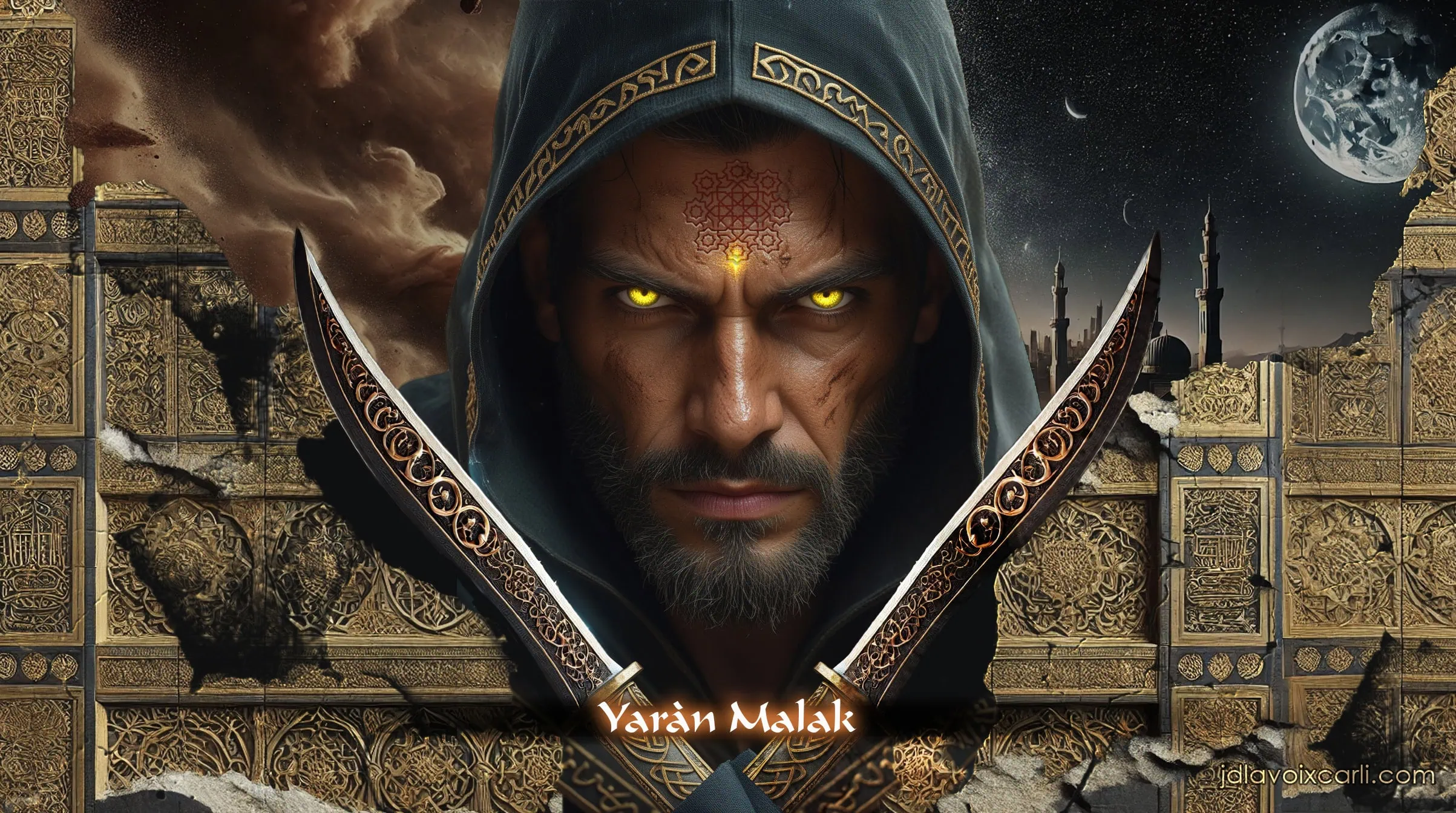
🕹️ I have won the Character Design and Concept Art contest generated by the independent game studio Guild Studio on their game “Shadow of the Guild”.
The Guild Studio launched an open-to-all Character Design contest for every creator to propose their own vision of the main character of the game : Yaràn Malak.
This contest took place on the rising community videogame platform Gamearly, which connects creators, video game studios, and their communities ensuring their independence and creative freedom.
The Game’s Community then decided by vote who should be the winning proposal. Below is the creative process I developed for the proposal that won the contest.
Foreword about AI
Is AI replacing creativity?
If you see yourself as a doer, you will be replaced by AI.
If you see yourself as a creator, you will be served by AI.
AI doesn’t replace creativity; it complements it: it’s just another tool on the crafter’s table, just another color on the artist’s palette.
AI is no more dangerous for creativity than felt-tip pens were when they were added to charcoal, or when Photoshop gradients replaced the compressor-powered airbrush. Just because everyone has a camera in their smartphone doesn’t mean there are no more professional photographers.
Because creativity doesn’t reside in the tool; it resides in the way it is used.
Experience, artistic culture, sense of composition, symbolism of colors, pictorial narrative, the hierarchy of forms and so many other things that make an artist unique cannot be replicated by AI. And this for one reason: AI feels nothing.
Art is a subtle connection between two living beings, two backgrounds, two cultures, two universes ; each of them being unique and developed, felt, lived in a unique and organic way.
AI is nourished by all cultures and all experiences to be able to respond to all technical requests ; therefore it cannot “understand” this exclusive connection. Because it has no narrative and artistic culture of its own, then it doesn’t understand the narrative and artistic culture of the human spectator. It is as simple of that.
What makes a work of Art is not only the quality of the treatment, the accuracy of the colors, or the precision of the line…
The ultimate test of a true work of Art is how it makes you feel.
And since AI does not understand the importance of feeling—because it is incapable of this manifestation—the processed result can only be incomplete, always. AI will always need a Guide who can order it to match such subtle combination of colors, such composition, or such hierarchical ordering of shapes that will trigger an emotional reaction in the viewer.
Because AI doesn’t differentiate between a flower and a can of soda ; it doesn’t understand the symbolic implications of Blood Red and Lilac Mauve ; it doesn’t understand the difference between a gaping wound and a smiling mouth.
AI is the Disciple, and the Creator is the Master.
To be afraid of AI is to be afraid of change. And to be an Artist is to embrace the essence of Change.
Why not replace Artists with AI?
When people ask me why an Art Director, an Illustrator, or a Photographer are still necessary in the era of AI’s “perfect” (sic) images, I simply ask two questions:
“Who will write the prompt and who will appraise the relevance of the result?”
Will it be the company’s accountant? The executive secretary? The head of marketing? The CFO? The CEO? The intern? The cook?…
…or will it be someone who will understand what needs to be asked to AI to convey an emotion to a human being?
…someone like an Art Director, an Illustrator, a Photographer.
A Creator.
A New Era Begins
However, a new era of artists is dawning, because AI is an extremely powerful and interesting tool for developing new aspects of creative production: its speed allows for the rapid development of strong concepts, its flexibility allows for near-real-time reaction to any given suggestion, and its variety of styles allows for the exploration of new avenues of expression, new ideas connecting, new concepts with great economy of means.
In the future, creators will be able to instantly bring their visions to life in the real world: creating holograms, 3D models, 3D printed objects, and other means that we can’t yet imagine. Creation through words, voice, and thought! Pure creation through pure imagination.
Imagination alone will separate true Creators from non-creators.
How I work with AI
So here is my method for reconciling human creative design with the AI Tool. Because, in the following example, it wasn’t the AI that dictated its vision to me; it was Me who dictated my vision to the AI and then perfected it.
At the beginning, there is always Imagination. Always. A story. A vision.
From this vision, I create a sketch. A drawing.
From this sketch, I break down the elements into different fragments that I generate with one or more AIs, with a very precise idea of their final arrangements.
Selection is very important: I can spend some time before refining the choice of AI creations so that it is as close as possible to my initial vision. I can also refine the prompt(s) more and more to achieve this result. Being an Art Director, or simply an Artist, means making drastic choices, all the time.
The method of creation through AI is similar to the action of Alchemy : once the vision is shattered and scattered into several elements, once the Dissolution is complete, comes the moment of Coagulation.
I bring these dispersed elements together. I unify them —in this case, with Photoshop, but many other softwares are possible— to create a single, strong visual entity where each element finds its place within the narrative hierarchy. Each element complements and completes each other other into a coherent, cohesive and harmonious whole.
If manual retouching or hand brush perfecting are necessary, I do them to bring completion to this whole, as much as polishing a diamond after having cut it to its final shape grants it with its final glow.
The Transmutation is achieved and the Vision is now complete.
The Design
Choice of Art Direction : AI and Manual Intervention
As the character is both an Assassin and a Wizard, I based my work on the principle of complementary duality, which would be reflected in the graphic charter. Namely: Black and Gold.
Black: Shadow, Night, Concealment, and therefore the Assassin.
Gold: Desert, Sand, Power, Wealth, and therefore the Wizard.
To create an efficient and fast enough concept art, I opted to Production Techniques mixing 20% Manual Design/Retouching and 80% AI based :
Production Techniques:
AI Part
- Dall.E : Wall Texturing, “Janbiya” Blades, Background
- Leonardo.AI : Main Character face and Costume
Manual Part
- Flaticon : “Rub El Hizb” PNG symbol
- Paper & Pen : Initial sketches and concept rough
- Pexels : Cracks and Fissures effects on the wall
- Photoshop : PNG Forehead’s Symbol insertion, layer masks fusion adjustements, colorimetry, hand brush corrections and Typography


Character Design
Once the my vision of both the Character and its Narrative impact have been set, I create a conceptual rough/mockup in 10-20 minutes to set in place the elements which will help me to sort out which elements will be set as AI and which ones will be adjusted manually :
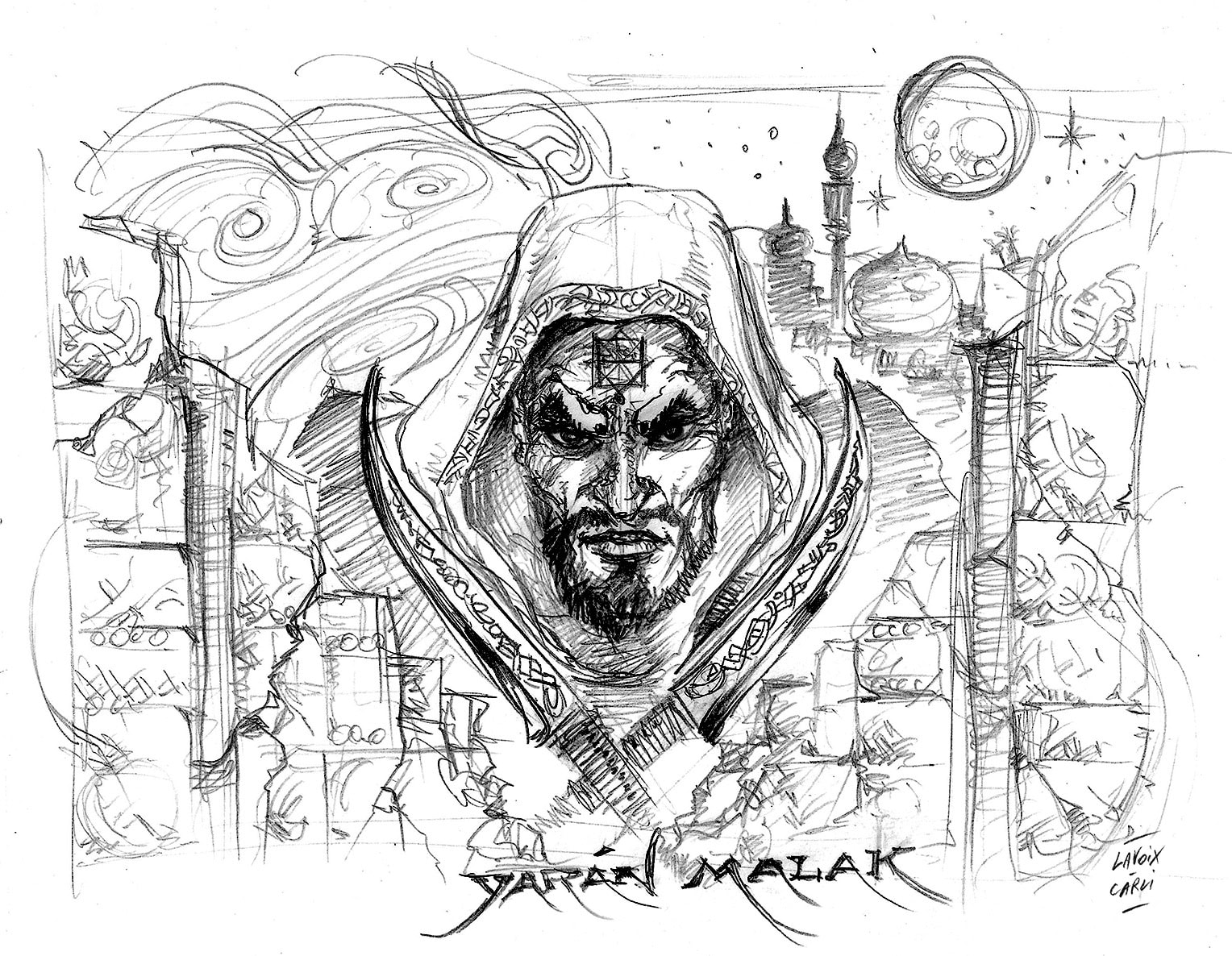
I then decompose the whole rough visual into separate -yet coherent- elements/base principles according the productions techniques needed. The whole will need to be united into a single graphic atmosphere to create an impactful visual :
Persona
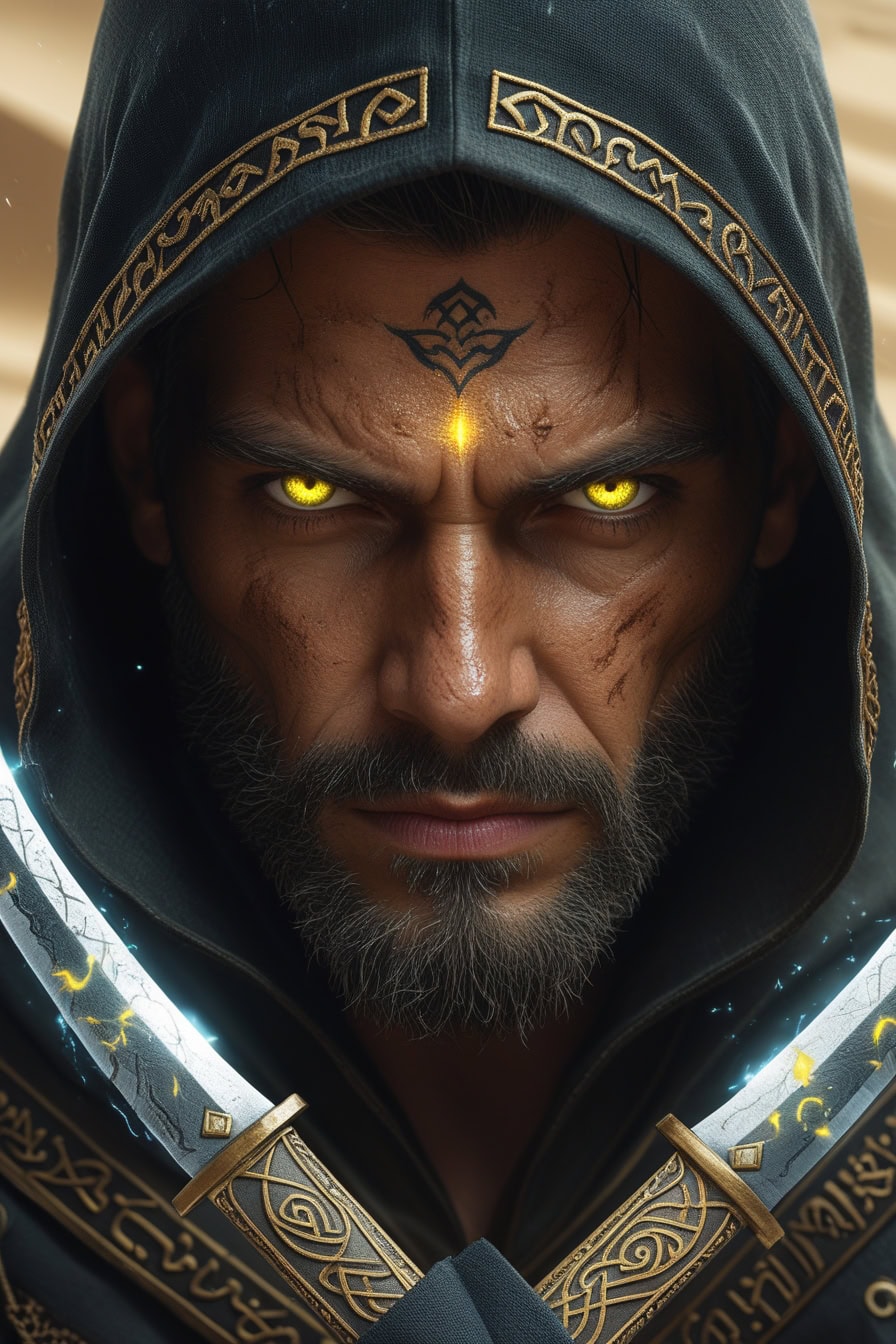
The character is in his early thirties: young enough to perform physical feats but also old enough to have the wisdom and knowledge necessary to wield the Arcane magical power.
Costume
As the game is somewhat inspired by Prince of Persia, I wanted to give him a Middle Eastern clothing style, where the hood evokes both the assassin’s concealment and the wizard’s prestige. The costume would therefore be black, enhanced with embroidery and magical arabesques in gold edging on the garments’ trim.
Weaponry
The weapons depicted in the visual are two Janbiya (Arabic daggers with curved blades), also with black blades etched with gold runes, symbolizing his ability to master the dual threat of physical strength and magic.

Distinguishing Features
The symbol inlaid on his forehead also has a dual meaning:
The first meaning is the Rub El Hizb, a Middle Eastern eight-pointed star indicating his membership in the Assassin sect as a ritual scarification.
The second meaning is that of an Octogram, an eight-pointed variation of the Pentagram, indicating that magical energy is—so to speak—embedded in his mind. Hence also the yellow glow, symbolizing the magical power bubbling within him, which illuminates one of the lower branches of the Octogram.
This magical energy has also corrupted his soul, coloring his pupils with a menacing yellow whenever he calls upon this dangerous energy.

Background and Graphic Ecosystem
Environment/Atmosphere
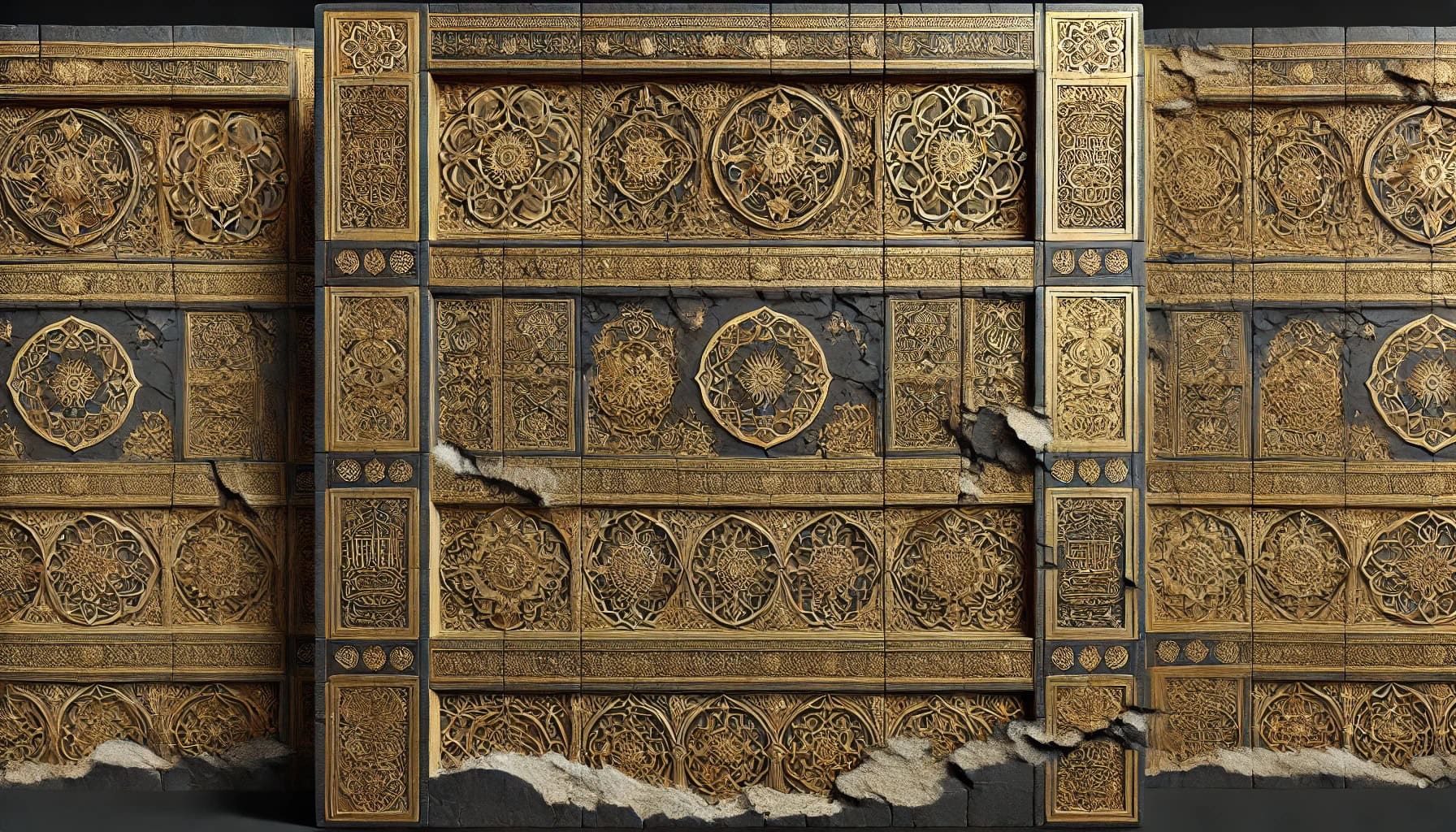
His face dominates a texture of ornate middle-eastern ruins, vestiges of the past and mysterious glory of a ruined civilization that he explores to make the most of. The “Old Gold” appearance of the wall inlays and the gaping cracks remain consistent with the character’s Black and Gold graphic style, unifying the whole.
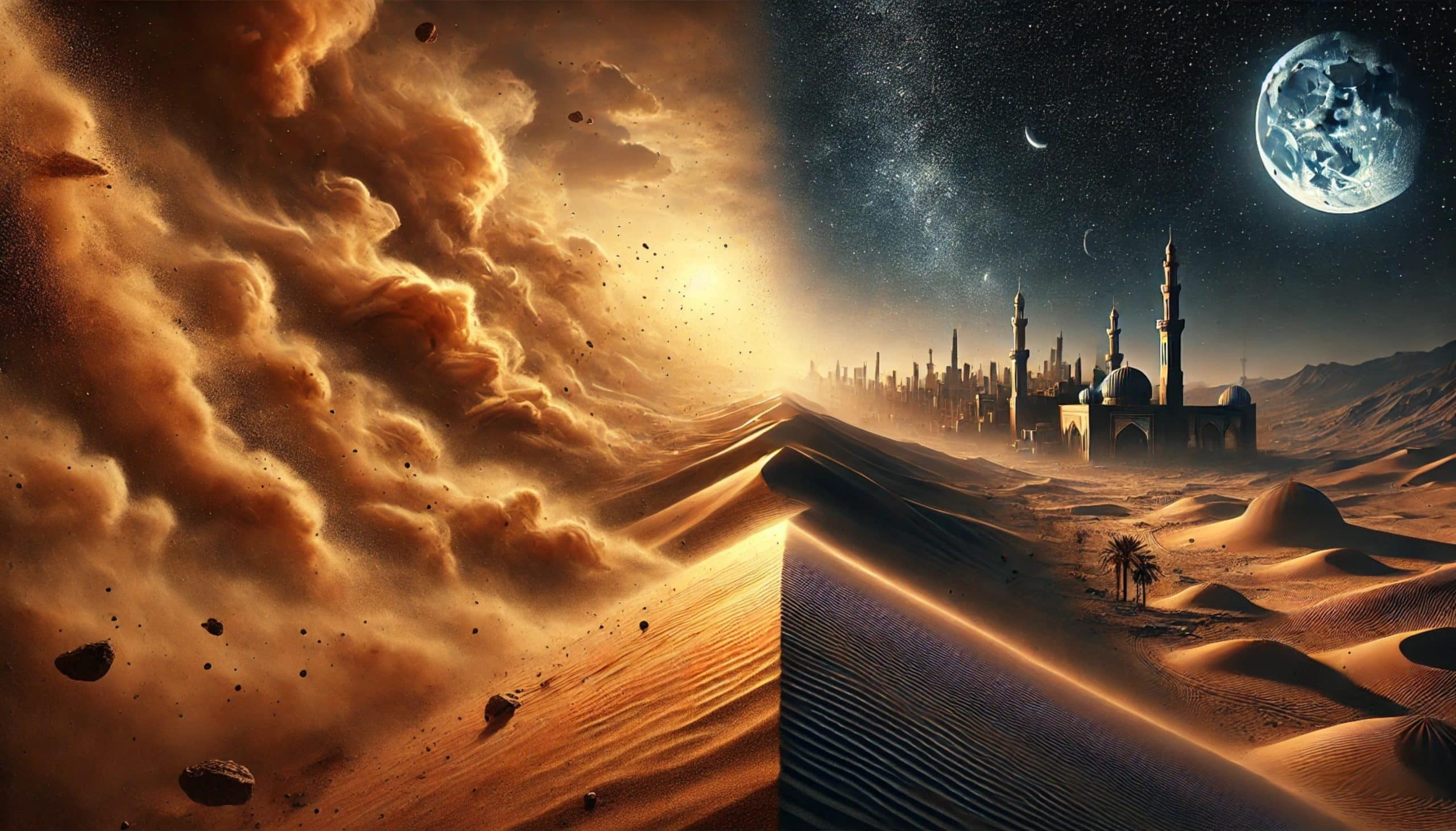
In the background, the landscape on the left represents Desert Storm, the character’s ecosystem as dangerous and unpredictable as he is. Its sandy color reflects the graphic style of Gold—and therefore the power of the Mage.
The landscape on the right represents night falling on a Middle Eastern city in the heart of the desert, plunged into shadow, favorable to the assassin and his modus operandi, his preferred terrain; Compliant with the graphic charter of Black—and therefore the Assassin‘s concealment.
Typography
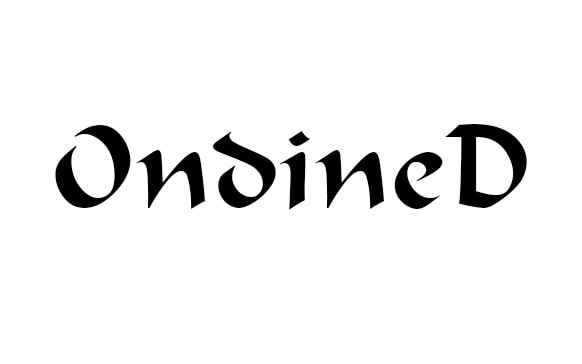
The typeface of the Character’s name is Ondine. It’s a cursive-style font with a Middle Eastern calligraphic soul without the excess of a “Fantasy” font, to maintain the seriousness of the game’s spirit. It is consistent with the character’s spirit while maintaining excellent readability.
About…
WHAT IS GAMEARLY ?
Translated from the Gamearly official description
Gamearly is the ultimate gaming ecosystem platform for game development. It aims to onboard gamers in the video game creation adventure to gather feedbacks and engagement, therefore improving both game curation and discoverability while maximizing gamers retention.
It helps game creators by monetizing their game from prototyping to post-launch, hereby gamers can support the game creation adventure. This platform is also giving a space where creators can distribute their creations and improve their visibility.
It is connecting indie devs & studios to artists in order to optimize game production. Also refering publishers with data on live creation Gamearly game projects.
WHAT IS “THE SHADOW OF THE GUILD” GAME ?
Translated from the Shadow of the Guild Studio official description
Inspired by the world of the Rain Merchants’ Guild novels, Shadow of the Guild is a platformer, combining beat’em up and stealth. You’ll deploy your skills as a warrior, mage, and assassin through spectacular combos, devastating spells, and stealthy assassinations to defeat your enemies!
Features
RPG
3 skill trees to choose from: Warrior / Mage / Assassin
Beat’em up: Dynamic combat where you can combine combos with your mastery of lightning
Infiltration: Want to stay in the shadows? Stealthily assassinate your enemies and enjoy the animated cutscenes we’ve created especially for you!
Items
Consumables, throwing weapons, and a whole host of runes to give you new skills
Story: A beautifully crafted story, created by the writer of the “The Rain Merchants’ Guild” books
Exploration: Side quests, special items, secret passages
Shadow of the Guild is
- 5 story-driven levels with their own visual identity, enemies, and cutscenes
- Combos and 10 devastating spells to take down your enemies
- Different assassination cutscenes for each enemy depending on your positioning
- 4 to 5 hours (on average) to complete the game
- A unique graphic style
- A tribute to Prince of Persia
Story
Aridia is an arid planet where water is a rare commodity… Where magic is omnipresent… Where the blacksmith is a pyromancer and the builder a telekinetic… On the planet, the different kingdoms call upon the The Rain Merchants Guild, the most powerful trading organization in the world, to provide their population with water.
From its flying fortress, the Guild sends hundreds of flying ships to capture clouds and resell them to the highest bidder. Their mastery of the skies is complete despite regular attacks by the Pirates Guild.
Faced with this hegemony, the Eastern Empire refuses to employ the Guild’s services, building its own fleet of flying ships and attempting to revolutionize the water trade on the planet. The empire is led by Emperor Gethro III. Investing heavily in scientific research, Gethro III fears that his discoveries will attract covetousness. The emperor then decides to close his borders and impose drastic controls there…
Ten years later, a discovery, made at the cost of immense sacrifices by the Informers’ Guild, suggests that the emperor has managed to create clouds using a new technology, freeing himself from the laws of nature and the Rain Merchants’ Guild’s monopoly.
The Guild cannot stand by and decides to send its best personnel into the empire to discover this new technology… without forgetting to wipe out all traces of its existence and all those who worked on its creation. This is where your story begins…
This post belongs to the Category :
Check my latest posts!
- “The 4M” : Designing Superheroes for Public Health
- Site Update : World Architect Offers
- Interview with a Compeer #1.1 : Desfragmentations – “The Alchemical Vision”
- Using AI creatively : Character Design – Yaràn Malak
- Article Header Design: “How to use AI for Weak Signals – Trump, the International Revolutionary?”
Check the latest comments!
Thank you very much for your comment coming from an IT expert, Nouha!
Very interesting article and excellent choice for th Sphinx!!
Splendid as always! And also this showcase the very broad scope of your design skills!


Related Themes :
Related Links :
Your comment will be posted after approval
Leave a Comment