






⭕ How can a complex geopolitical issue become an image that people understand and remember?
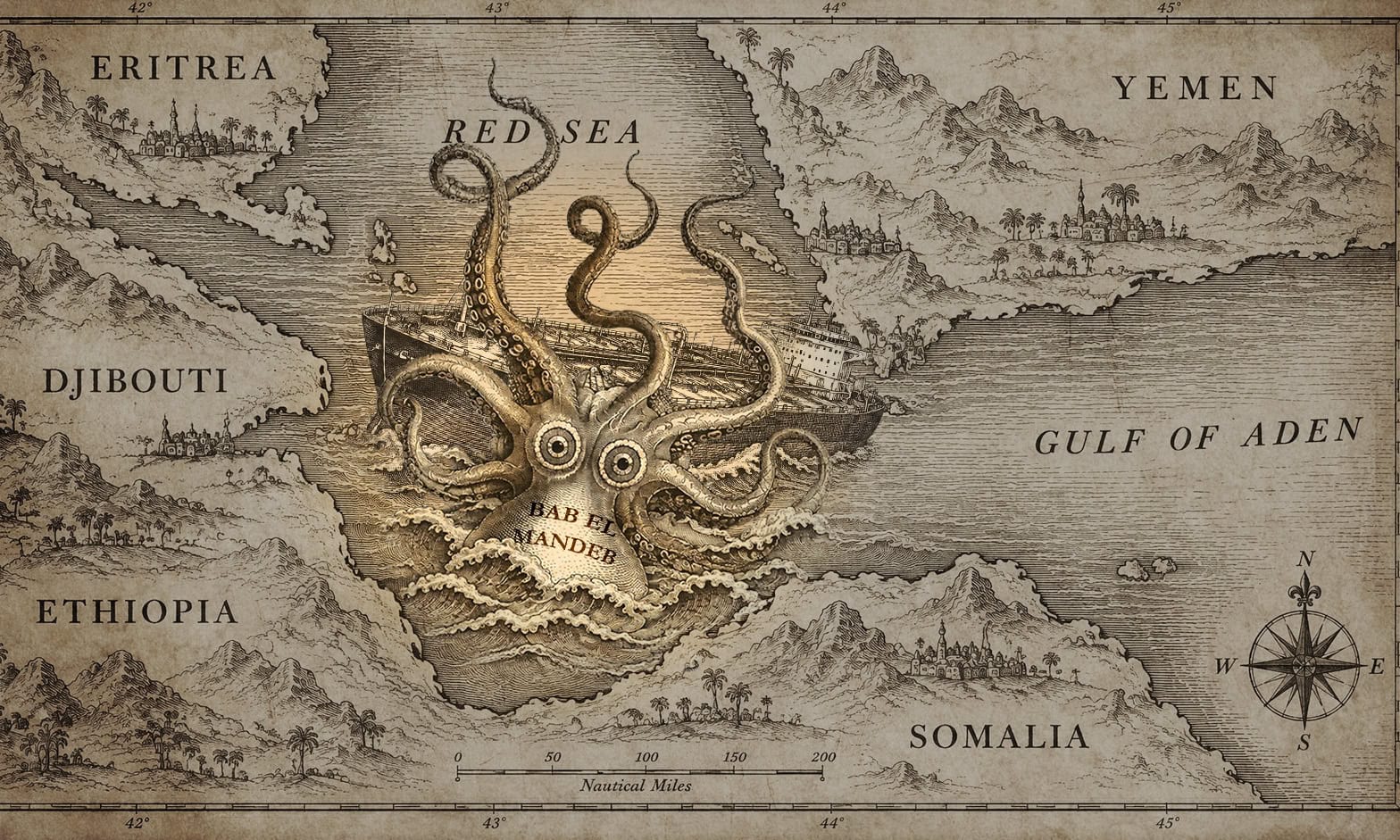
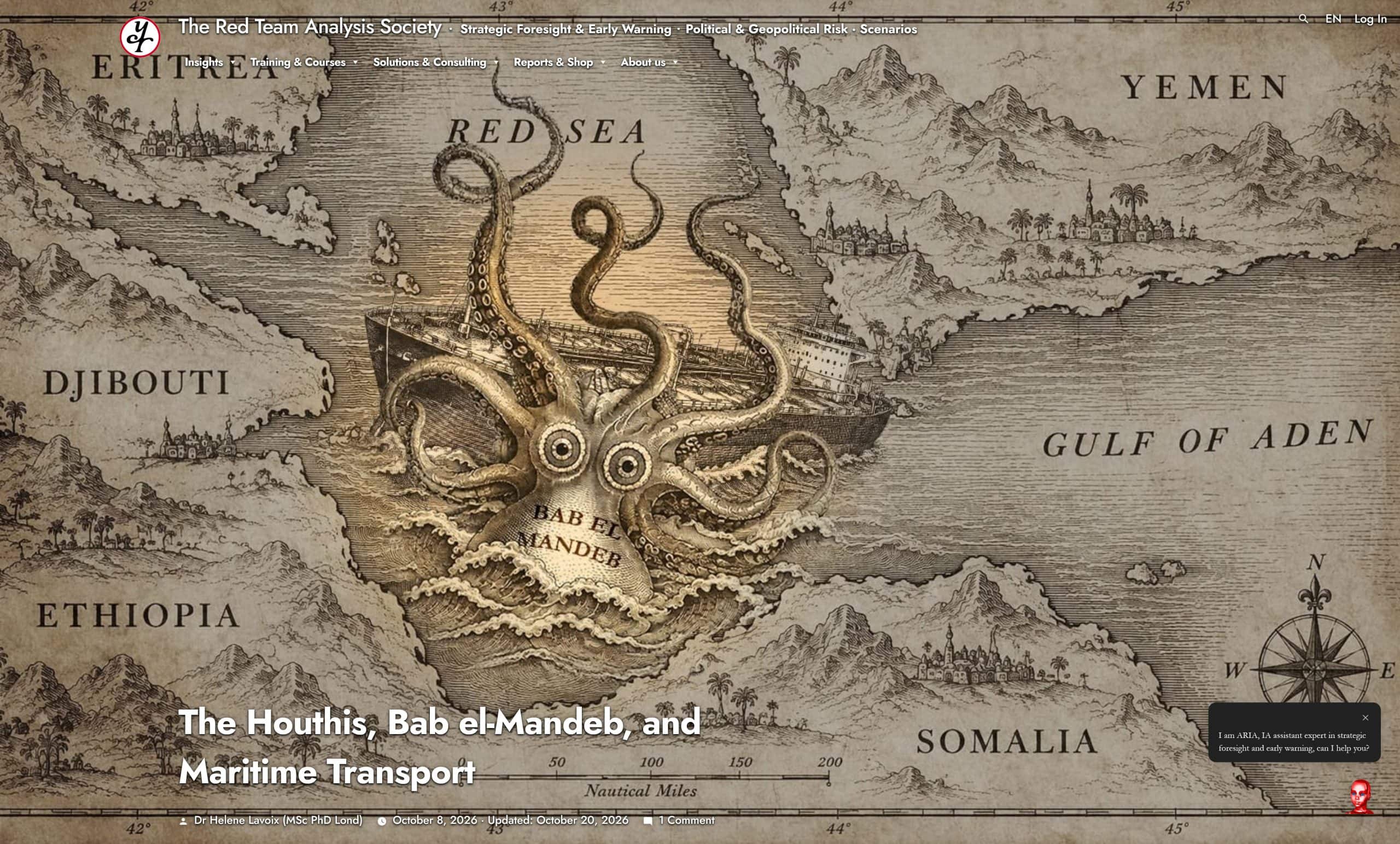
For The Red Team Analysis Society, I developed a visual metaphor connecting an ancient maritime monster to a modern strategic chokepoint ; turning a complex issue of maritime insecurity into a single, memorable image.
The illustration was subsequently shown during an interview on Italy’s La7 programme Piazzapulita.
This interview can be watched here : “Houthi a bab el-Mandeb: tra insicurezza marittima ed escalation militare”.
The Context
⭕ The design I created for The Red Team Analysis Society article [🇫🇷 🇬🇧] is titled:
“The Houthis, Bab el-Mandeb, and Maritime Transport”
The war in Yemen has entered a new and dangerous phase, with the Houthis seeking to strengthen their position along the Red Sea coast and around the Bab el-Mandeb Strait.
In September 2026, their reported capture of Mocha, the Hanish Islands, Dhubab and Perim Island marked a significant escalation, giving them a direct territorial foothold around one of the world’s most critical maritime passages. Although some of these territorial gains were reportedly reversed in October, the Houthis’ ability to threaten shipping through the strait remains a major concern.
This shift came after months of relative restraint during the wider US-Israel-Iran conflict. Hostilities involving the Houthis intensified in July 2026 and have since contributed to growing fears of a broader regional confrontation.
At a time when disruptions in the Strait of Hormuz are already placing severe pressure on maritime transport and global supply chains, renewed instability at Bab el-Mandeb threatens another vital link in international trade.
Connecting the Red Sea to the Gulf of Aden and providing access to the Suez Canal route, Bab el-Mandeb is a strategic chokepoint whose disruption can force ships to take longer routes, increase transport costs and amplify delays across global supply networks.
The evolving conflict therefore raises a critical question: how far could the Houthis’ expanding ability to threaten this passage reshape maritime traffic and its wider economic consequences?
The Design
The Concept
We have all believed ourselves to be living in a modern world : Technology, Worldwide Travel, Abundance, Satellite View, instantaneous Communication, Manufactured Goods and absolute knowledge which seems to have banished the mistakes of the past : Superstition, War, Famine and… Monsters.
But when I have witnessed the scope of the consequences of war : blockades, restrictions, war on earth, war on the oceans ; a sudden epiphany struck me : we have never been modern and the world did NOT change since the ancient times.
It just changed shape.
But it still bears the same original stakes, the same original sins, the same… monsters.
Therefore, in a sort of counter-intuitive way, I have decided to treat visually a modern conflict with an ancient style : the one of 14th-century portolan charts : old parchment background, engraved linework and exaggerated menaces of the ocean in the guise of an immense Kraken – the ones the sailors of yore were fearing when they were entering the dreadful Terra Incognita of uncharted oceans…
And, as in the old maps, I have named that dreadful Kraken “Bab El Mandeb”… because the fear it inspires is no less than the one felt before, when the sailors were fearing to fall down in the Void which lies beyond the limits of the ocean of a flat world…
Except that now, sailors no longer fear the Kraken’s tentacles tearing their sails or breaking their masts… They fear supertankers and freight ships being struck by drones, missiles and kamikaze vessels.
Indeed, the Kraken is now far more powerful since now it is even more unexpected, even more invisible, even more unpredictable.
As, since now on, the Kraken has become the strait of Bab El Mandeb itself.
And the anguish felt by 21st-century sailors approaching this monster is now the same as the one felt by the sailors of the 14th Century : as they discover that the unknown dangers of the seas have not disappeared…
They have just changed their appearance.
And the old strange monsters of yore are now feared even more ; as their names are no longer unknown…
They bear the names of geopolitical consequences.
The Technique
○ To create that “old portolan chart” feeling and apply it to modern concepts, I used AI to create three separate elements:
- The geographical map used as the background
- The Kraken figure, on a transparent PNG background
- The supertanker stranded behind it, also on a transparent PNG background
The ship and the Kraken needed to remain independent, giving me enough room and freedom to position them without creating any awkward or inappropriate interactions with the background map.
○ For the map, I crafted a very specific prompt to recreate the texture of old maps, the graphic conventions of antique nautical charts, and the country labels used at the time, along with the full range of pictograms and decorative elements traditionally used to represent cities, deserts, waves, oases, and more.
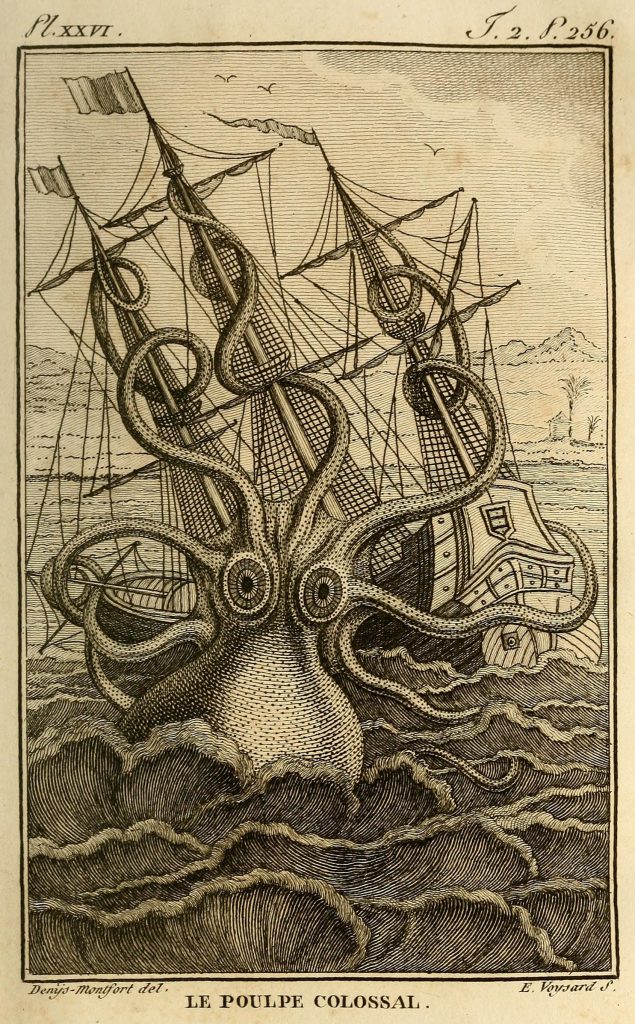
○ For the Kraken, I uploaded a typical 19th-century illustration by Dénys de Montfort, in the public domain, as a visual reference. That engraving depicted exactly the kind of sea monster I needed to convey my concept. After many attempts and corrections, the AI finally produced the Kraken I needed for the image. However, because it could not properly separate the tentacles from the mast in the original illustration, I had to rework them manually in Photoshop.
○ For the supertanker, which needed to be depicted in exactly the same style as an antique engraving, I reinforced the prompt with terms such as “antique engraved aesthetic,” “parchment,” “cross-hatching,” “stippling,” and “fine copperplate linework.”
○ I then assembled the three elements into a harmonious composition, adjusting their scale and position until they were both immediately readable and capable of embodying the chokepoint of Bab el-Mandeb.
○ Since old portolan charts traditionally included the names of sea monsters (see the examples of “Balena” and “Orcha” below), I used this antique convention to reinforce the final point of the concept: the dangerous Kraken is Bab el-Mandeb.
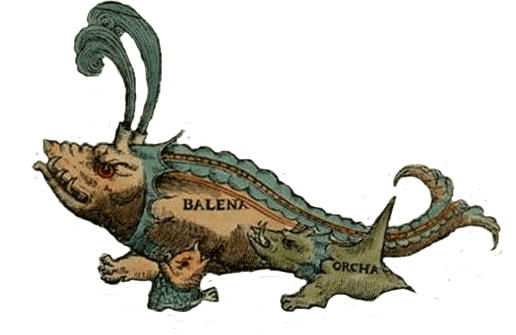
○ To embody this identification and connect it to the visual language of old portolans, I added the word “Bab El Mandeb” over the Kraken’s body, using Garamond and slightly distorting the lettering to follow its form.
○ Finally, I subtly overlaid another aged parchment texture across the entire image to make it feel even more ancient and weathered. I also adjusted the color grading in different areas, bringing the Kraken–supertanker confrontation into focus while toning down the colors of the surrounding map.
This served two purposes :
First, it directed the viewer’s eye immediately towards the central, iconic representation of the threat.
Second, it introduced a metaphorical dimension: the conflict was draining the life and color from the surrounding countries, concentrating them into a single, heated focal point of war.
The World Architecture application
World Architecture is not only about fictional worlds, it is not only about the visual, it is not even about a single Narrative at a single time.
It is to understand what connects visually, conceptually, coherently and essentially every single aspect of a world and how every aspect affects this world in return.
Through Space and Time.
Summary of the Topic
🔻 Description of the key role of the Bab el-Mandeb Strait in world trade.
🔻 Extensive chronology and analysis of the Houthi attacks and their impact upon maritime traffic worldwide via Bab el-Mandeb.
🔻 Extensive presentation of the potential future impacts of this situation on world scale.
This post belongs to the Category :
Check my latest posts!
- Article Header Design: “The Houthis, Bab el-Mandeb, and Maritime Transport”
- “The 4M” : Designing Superheroes for Public Health
- Site Update : World Architect Offers
- Interview with a Compeer #1.1 : Desfragmentations – “The Alchemical Vision”
- Using AI creatively : Character Design – Yaràn Malak
Check the latest comments!
Thank you very much for your comment coming from an IT expert, Nouha!
Very interesting article and excellent choice for th Sphinx!!
Splendid as always! And also this showcase the very broad scope of your design skills!


Related Themes :
Related Links :
Your comment will be posted after approval
Leave a Comment